

When all else fails, just try.
Nearly two years ago, my boss died unexpectedly. This is the story of what happened next.

Some lessons arrive in ways you never expect.
In 2023, a week before my wedding, I left my job.
I had been there for over two years, and I loved it. The work was challenging but fun, my colleagues were amazing, and I was learning a lot. But my manager and I no longer saw eye to eye, and eventually the environment became too toxic to stay.
I spent nearly five months without a job. The first two were a real break; I didn’t polish my resume or visit a single job board. Completely burned out, I spent the holidays recovering and processing the heartbreak of leaving a team I cared deeply about. I worried about who would take care of them now that I was gone, and whether I’d ever find work I enjoyed as much again.
In January, I started applying for jobs, and by March I had a new role. I was excited. It was the same position (Director of Product) in a similar industry: technology for architects and designers. The company was smaller and younger, with an ambitious vision. I would be the only person in Product, working alongside the CPO, who would be my direct boss.
We got off to a slightly awkward start. The job was fully remote, and I had never worked remotely before. I quickly learned that building relationships over Zoom is harder. My boss was the go-to person for everything. He ran engineering, product, and data, and seemed to have a hand in nearly everything else. He was incredibly smart and deeply respected across the company. Everyone adored him, and it was easy to see why. Not only did he seem to have the answer to everything, he had the right answer, and he carried a quiet gravitas that made people trust him.
At first, I struggled with that dynamic. I was assigned one project, and everything I did had to go through him. I didn’t have the usual working relationship with Engineering that product teams typically do. As a director, I sometimes felt like I was barely contributing to the vision at all. I even had to ask repeatedly just to test the product before launches. I started to wonder if he didn’t really want me there—or maybe just didn’t like me.
That summer we were preparing to launch two major features that had been over a year in the making. He had designed nearly everything himself: writing tickets, running standups, and leading most meetings. At the same time, he was still acting as CPO and co-founder, juggling projects across the company. Eventually our CEO and chairman insisted he share the launch plan with me to relieve some pressure. I was thrilled to finally contribute.
By late May, things began to shift. We were talking every day, often for hours, and started developing a real rapport. He began listening to my ideas, and we worked together on shaping new projects. We joked about small things, talked about the importance of sunshine for happiness, places we wanted to travel. I kept asking him for a roadmap. One day he said, “We have one, but I haven’t updated it in almost two years. I’ll share it with you later.”
He started asking the team about expansion and what talent we should hire next. In June, two new people would join us. In just a few weeks we would launch our first major product release in years.
For the first time since I joined the company, it felt like we were finally becoming partners. I felt settled.
A Thursday morning in June, 7 am. My phone rings - a call from our CEO.
“There’s been an accident. He was cycling, and he was hit by a car. He’s in critical condition, and he is now in a medically-induced coma.”
Like clockwork, everyday after work, he’d go cycling. He was training for some kind of triathlon, or something similar. The day before, he’d finally shared that roadmap with me. Half of it was blurred or blank. I asked why were there so many blanks; he said “I haven’t figured it out yet.” I thought maybe we can figure it out together.
His last slack message to me: “Are you good?”
To which I replied, “Yep. See you tomorrow.”
I had a friend/colleague at my last job who had suffered from a traumatic brain injury after a horrendous car crash. He survived - in fact, today we work together. I thought that my boss would be the same. He was a young guy. We just realized days before that our birthdays were five days apart, same year. We laughed at the funny coincidence of being Libras.
That morning, I operated as if my job is just keep things moving and not destroy the product, and have a successful launch, so that when he came back, he’d be relieved and proud. We’d just pick back up. In between meetings, I was reading Reddit threads about people who had survived traumatic brain injuries after vehicular accidents and their recovery times. Some people recovered after three months, some after a year. I thought - no big deal, he’d be back by our birthdays. He was very active, in amazing shape, ate right - all the right ingredients for a speedy recovery.
I don’t remember how the first standup was that following week, except that it was awkward. He usually ran those group meetings. I don’t think we said anything about the accident - I wondered if maybe we were all on the same unspoken mission: keep things moving until he’s back. And that he will come back.
My husband and I decided to drive to my in-law’s for the weekend. On Sunday afternoon, I was setting up my laptop in my mother-in-law’s computer room, when I accidentally saw the message.
He passed away.
I think I screamed. I don’t remember much after that—just the tears, and a sudden wave of fear. Fear of what, exactly, I couldn’t say.
I went for a walk and called some of my colleagues. I talked to my other boss, the CEO. I couldn’t imagine what he felt - he had lost a close friend, a co-founder, a partner. And now he was alone, with a massive responsibility to shoulder.
The next day, we didn’t work. I don’t really remember what all I did that Monday, but I think I made it a mission to keep it together. He loved this company, he loved everyone at work, and he always took care of them. I think I felt like it was now my job to do all of that in honor of his memory.
Tuesday was weird. The morning standup was awkward, depressing, and eerily quiet. I didn’t know exactly how to “be”. It felt like the longest 30 minutes of my life. I started to look for documents, so I could learn as much as I could about his plans, about how he would run teams.
In the midst of all of this, I was promoted to Senior Director, and now my job was to manage the Engineering team and our Data team. I had never worked in Data that deeply, nor Engineering. Our CEO asked me what I needed; and I said I needed a Product Manager and a Designer. I knew immediately who to call for a Product Manager. We had to look for a designer. There was no way that I could fill his shoes without a team.
Grief knows no bounds.
I had known him for three months, almost exactly. We spoke for 15 hours per week, for almost 12 weeks (minus the time I was away at the beach and he was on vacation). 180 hours. I didn’t know him for a very long time.
I was surprised at the loss that I felt. I had only ever had one person in my life pass away who I was close to, and that was my grandmother. I didn’t know that you can feel such a sadness over someone who you only interacted with in a limited setting and a short amount of time.
Sometimes I felt as if I didn’t deserve to feel so sad because I barely knew him. Almost as if other people did deserve to feel so sad because they knew him longer or were closer. So at work, I made sure that everyday I was stable and there was room for others to be sad.
Eventually, I confided in a colleague on a particularly tough day that I didn't know I could be so sad over someone I barely knew. Her response is one opened my eyes: “Grief does not care about how long you’ve known someone. Grief has no baseline.”
I watched my colleagues express their sadness in his memorial website and on the slack thread about the announcement of his passing. Grief also does not care that you’ve never physically met. Grief does not care about geography or time. Grief does not care if that was your boss or your best friend, or a stranger.
Impostor syndrome is real and she’s a real b****.
The slack messages about launches and what’s next with product kept pouring, because the business had to keep going. No one said it out loud, but the unifying question that I felt I had to answer was “What do we do now?”
When I first applied for this job, I applied for a customer experience role that required two years of experience. I wanted something “easy” (I now know people in this role and what they do is nowhere near easy). I wanted to clock out at 5 PM everyday and not think about my job.
Life had different plans because I ended up accepting a product leadership role. And after his passing, I felt like I had unknowingly strapped myself onto a cannonball.
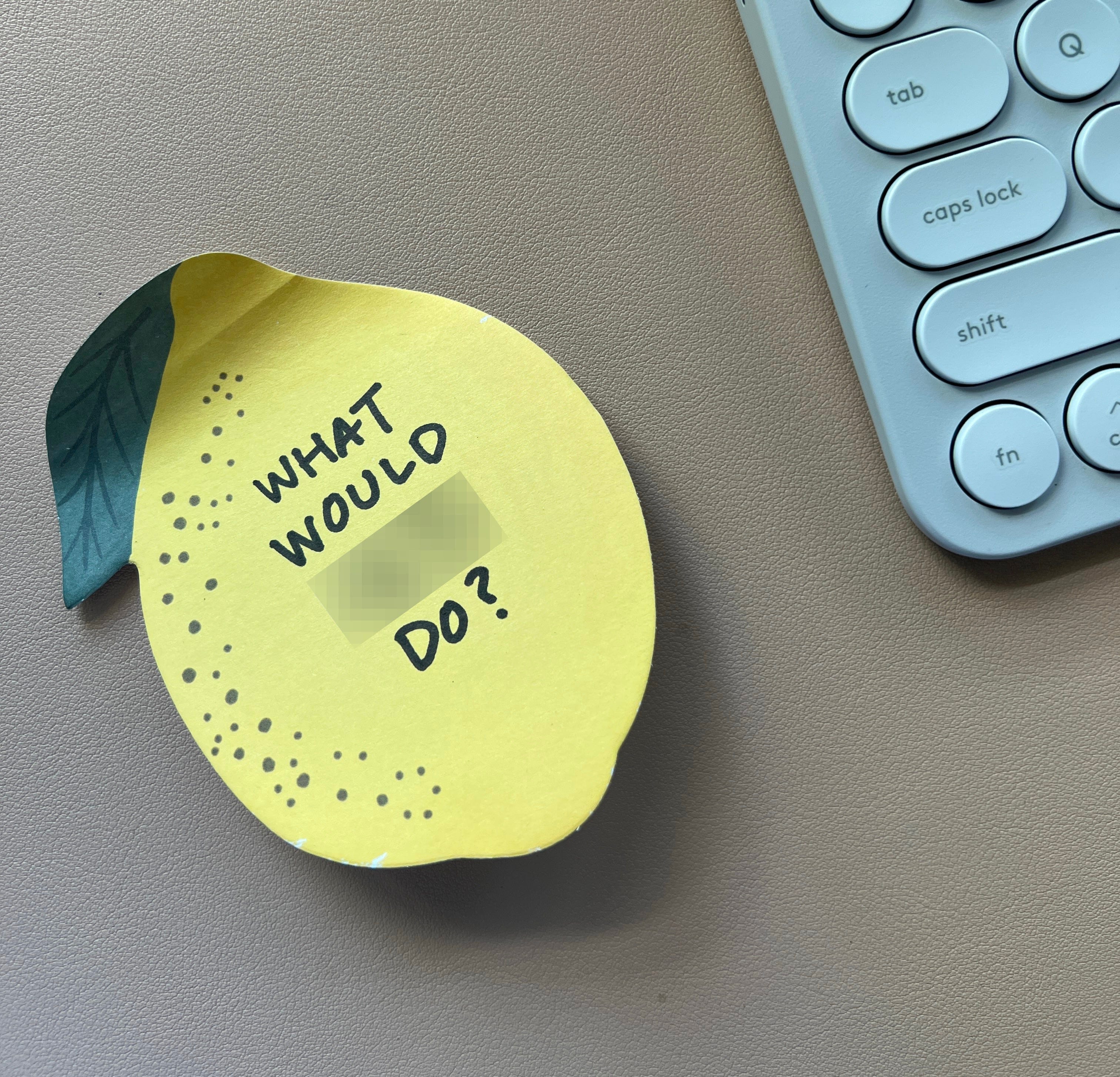
For over a year, I kept a sticky note that said “what would [he] do?” as if looking at it would give me the right answers to people’s questions. Sometimes it worked. I kept notes of our meetings so I had some ideas of how he would steer the ship. Most of the time, it didn't work. I had to come up with the answers myself. This was now my responsibility.
Coming up with answers by myself was ridiculously hard. I felt like I was just being watched all the time, and that people were comparing me to him. In the back of my mind I feared that the team was getting a massive downgrade, and at some point they would clock this and I’d be fired. I have an undergrad degree from a small state school. Not MIT. I barely knew anything about AI, and the AI train in business was not slowing down anytime soon. If I didn’t catch up, we’d fall behind.
Around the same time, I was diagnosed with mild to moderate Obsessive Compulsive Disorder with a Completion Loop. It basically means that sometimes my brain gets stuck on details (mostly visual) that feel unfinished—like clutter or something misaligned. Even if I walk away, my mind keeps replaying it. When I fix it, my brain finally relaxes. With everything happening, there was so much that I couldn’t just “fix” in a day or two - my anxiety became so severe that I barely slept, developed eczema, and more.
In a lucky coincidence, I started back with regular therapy the Monday after my boss passed away. That was probably the best thing that’s happened - there was no way I was going to get through this wild circumstance without emotional guidance.
When all else fails, just try
When my boss died, I thought that I had to get smarter so that I could fix everything. Or, at least be as smart as he was. I considered going to grad school part-time, at nights. I started to look at some programs at Ivy League schools, because he went to MIT. I read as much as I could about AI, about product, about building teams, and anything that I thought I needed to learn to be just as good, if not better.
My calendar immediately blew up. So I stretched my days, starting at 7:30 AM and sometimes not quitting until 7-8 PM. Some Saturday mornings, I worked for a few hours to catch up. I didn’t want anyone feeling like there was now a gap - which was silly, because of course there’s a gap that I could never fill (I know that now).
I became a real stickler for documentation and systems. After his passing, I realized documentation about anything was sparse. Some may have existed but no one had access to them. This was the moment where the fragility of life and the implication of it to others, even in the most functional sense, dawned on me. I was on a mission to make sure that we would never end up in a situation where if I or anyone were to suddenly disappear, the rest of the team would be lost. My mantra was over communication is better than under. Today, we have documentation for nearly every idea, internal and external operation, and every feature and every functionality that touches my team.
I was completely exhausted, but I think trying so hard felt therapeutic. Trying is tangible - it’s something that translates into small tasks and every time I completed a task, it felt like checking something off my to-do list. I think I took comfort that if anything, at least I tried - and I had the task list to prove it.
At some point - trying so hard becomes trying too hard, and you can burn yourself out. I was conscious that I didn’t want to end up burned out again, but I wasn’t sure about threshold of enough.
No one achieves anything alone
In December of that year, in our last standup of the year, our Head of Engineering decided to take the next 30 minutes to just chat about the year. We all realized what a wild year it had been. The triumph of our first major launch, expanding the team, and the massive loss of our fearless leader. One by one, people started to share their own vulnerable thoughts about the year.
I don’t remember exactly what I said, but I shared something like “This was a very hard year, and I am so thankful for all of you. I hope we made him proud.”
Mentioning his name always felt risky. I was afraid that it would trigger sadness and ruin an otherwise fine moment. I was afraid that maybe I was just seen as someone who couldn’t stand up on her own or have her own thoughts. But at that time, I think I was just being honest - that was all I wanted that year. I wanted him to be proud of what we accomplished, wherever he was. That we managed to keep everyone together and continue to build on his vision.
At that moment, one of the senior engineers spoke up. One who was particularly close to him, one whose opinion I revered. He said that he recognized how hard this year must have been for me, being suddenly thrusted with the responsibilities I had, and that he was thankful that I was there. He saw that I took care of people and that I helped keep us going.
His words flipped a switch in me. A weight I hadn’t realized I was carrying suddenly lifted. I felt like I could breathe a little easier, and maybe I finally had done enough. I felt like I finally received permission to just be myself instead of trying to mirror who he was. I went into the holiday break with a lightness that I hadn’t felt in a while.
The great character Leslie Knope from the hit TV show, Parks and Recreation, famously said “No one achieves anything alone.” Working in a team makes that obvious; in a literal sense, everyone has their own role and responsibilities. But what I realized that holiday season is that our team would not be the incredible team that it is if we didn’t also see and were emotionally present for one another. We carried each other through grief, loss of a leader and direction, and an ambitious vision. We also had to learn to fully trust each other - I had to get to know and trust all of them, and they had to get to know and trust me.
Fast forward to today
I have been labeled an overachiever all my life, but that label has never felt quite right. A more honest description is that I am a striver. I have always felt like I was just trying to catch up.
I was never the top of my class. In the many competitive situations I’ve entered, I’ve only ever won one. I’m also not an inherently competitive person. If I’m honest, I think I’ve mostly just wanted to be thought of as enough. Maybe that sounds desperate.
The truth is that I will probably always be a striver. I live in the tension between confidence and humility about how much there still is to learn. Often, the closer I get to competence, the more I realize how much I don’t know.
But I’ve come to realize that there is something comforting about that. There is excitement in curiosity and in continuing to learn. I think my late boss and I shared that. Staying curious may be one small way I can continue to honor him.
These days, I’ve become much more relaxed because my team reminds me, by just being who they are, that I am not alone and that I don’t have to have all the answers. I know they see me trying, just as I see them trying. This sense of psychological safety has helped me to draw better boundaries and protect my time.
I no longer work 12 hours per day. I don’t work on weekends. I still start early in on weekdays, but not consistently - only when it’s absolutely necessary. My anxiety (and eczema) is under control, for the most part. I’m still working on not thinking about work during off-hours, but I’ll get there. I’ve started gardening again.
I’ve maintained a heightened level of discipline for my personal and my team’s routine, but I don’t see that as a bad thing. In the midst of all this, our product/business continues to do well and has been gaining more recognition in the market place.
If the last two years have taught me anything, it’s the importance of having a solid team and an environment where everyone has psychological safety. A solid team is one that isn’t afraid to be vulnerable, make mistakes, and truly see one another.
Sometimes the only way through hard moments is simply through them. And getting through is much easier when you’re not alone and when you feel safe enough to keep trying while you figure it out.